With liquid bioethanol for fireplaces you often see claims such as '99% pure bioethanol' or even '100% pure bioethanol'. This sounds appealing, but technically it is not correct. In reality, bioethanol never consists exclusively of pure ethanol.
What does the claim 'purity' actually mean and what should you pay attention to when choosing fuel for a bioethanol fireplace?
Ethanol always contains water
Even after distillation, ethanol always contains a small amount of water. This is because ethanol and water form what is known as an azeotropic mixture. As a result, ethanol cannot be purified indefinitely by normal distillation.
In practice, fuel ethanol usually contains approximately: 96% tot 97% ethanol and 3% tot 4% water.
To achieve an even higher ethanol concentration, additional industrial purification steps are required. Even then, a minimal amount of water almost always remains.
For this reason, a claim of '100% ethanol' is chemically impossible in practice.
Bioethanol contains another additive besides water
Because ethanol is also drinkable alcohol, it would normally fall under excise legislation for alcoholic beverages. To prevent this, fuel ethanol must be denatured.
Denaturing means that a small amount of substances is added to make ethanol unsuitable for human consumption.
Common denaturing agents include isopropanol or MEK (methyl ethyl ketone). These additives allow bioethanol to be sold freely as a fuel without beverage alcohol taxes.
What does '99% or 100% pure bioethanol' actually mean?
When manufacturers refer to 99% or 100% pure bioethanol, they usually mean that the product contains no additional additives other than the denaturing agents.
In reality, bioethanol consists of a combination of ethanol + a small amount of water + denaturing agents.
The difference between brands mainly lies in the quality of the distillation process and the purity of the raw materials. For consumers it is therefore important that the correct information is clearly stated on the label.
Claims such as '99% or 100% pure bioethanol' on a bottle of bioethanol are therefore not permitted, as they are considered misleading.
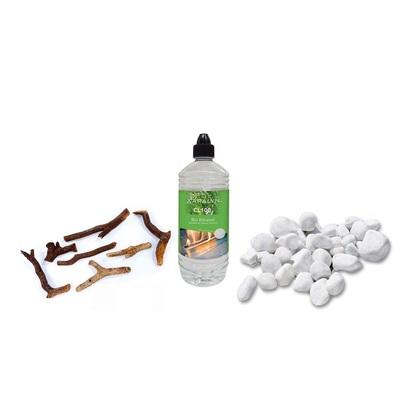
Xaralyn CL100 bioethanol is produced from fully organic and renewable raw materials. To comply with excise legislation, 1% isopropanol is added.
Why claims on bioethanol bottles are becoming stricter
Anyone buying bioethanol for fireplaces often sees terms such as 'eco', '100% pure' or 'premium quality' on bottles. However, manufacturers are not allowed to use such claims freely.
Within the European Union, there are clear rules for product labelling, including bioethanol. These rules aim to provide consumers with correct information, safety and transparency.
Bioethanol falls under chemical regulations
Fuel for bioethanol fireplaces does not fall under food or beverage legislation, but under chemical regulations. The most important European legislation is the CLP Regulation (Classification, Labelling and Packaging).
This regulation requires substances such as ethanol to be correctly identified by their chemical name or composition.
Misleading marketing claims are not allowed
In addition to safety requirements, legislation also addresses misleading product claims.
Manufacturers may not:
- use unclear or exaggerated claims
- use terms that are not verifiable or clearly defined
For bioethanol this means that terms such as '100% pure', 'fully organic' or 'eco fuel without emissions' can give a misleading impression and are therefore not allowed on product labels.
The use of the term 'bio'
The use of the word 'bio' is also sensitive. In Europe, the term “bio” or “organic” is strongly protected in the food sector.
For fuels the term may still be used, but only when:
- the product is actually produced from biomass or renewable raw materials
- the term does not suggest that the product is environmentally neutral or completely harmless
For this reason, some manufacturers now prefer terms such as 'bioethanol fuel' or 'ethanol fuel for fireplaces' instead of simply using the word 'bio'.
Readability and clarity of labels
New guidelines also set requirements for label readability.
Important information must:
- be clearly visible
- appear in sufficiently large lettering
- not be hidden by marketing text
Why these rules matter
Stricter labelling is not just bureaucracy. It helps consumers to compare products more easily and recognise misleading marketing.
Conclusion
The labelling of bioethanol is changing due to stricter European rules aimed at consumer protection. Manufacturers must provide clear information and may not use misleading claims.
Exaggerated marketing claims on bottles of bioethanol are therefore no longer permitted.
For consumers this is ultimately positive: it ensures greater transparency and more honest information about bioethanol as a fuel.